A kitchen floor has to do more than look beautiful under natural light. It has to handle dropped utensils, chair movement, splashes near the sink, and the daily rhythm of a room that never really sits still. That is exactly why hybrid timber flooring for kitchens has become such a strong option for homeowners and design professionals who want warmth underfoot without stepping into a high-maintenance material choice.
The appeal is easy to understand. Hybrid timber brings the visual softness of wood into a space that usually demands hardwearing performance. In a premium kitchen, that balance matters. You want a floor that complements stone countertops, refined cabinetry, and statement lighting, but you also need something practical enough for real use.
Why hybrid timber flooring for kitchens works
Traditional timber has undeniable character, but kitchens ask a lot from flooring. Moisture, spills, temperature shifts, and heavy traffic can all test natural wood over time. Hybrid timber flooring is designed to answer those pressures with a layered construction that prioritizes stability and water resistance while still delivering the look of authentic timber.
For many projects, that makes it an appealing middle ground between porcelain tile and hardwood. It is typically more forgiving underfoot than tile, warmer in appearance, and easier to integrate into open-plan spaces where continuity between the kitchen, dining, and living area is part of the design brief.
That said, not every hybrid floor performs the same way. Product quality, core composition, wear layer, and installation method all affect how well the floor will hold up in a kitchen setting. A well-chosen hybrid timber floor can feel elevated and dependable. A poorly chosen one can look flat, sound hollow, or struggle under daily wear.
The design advantage in modern kitchens
Kitchens have shifted. They are no longer treated as purely functional work zones hidden from the rest of the home. They are central living spaces, and the flooring has to support that transition. Hybrid timber suits this shift because it softens the visual tone of the kitchen and creates a more connected feel across adjoining rooms.
In contemporary interiors, wide planks in light oak tones can bring calm and openness. In more dramatic schemes, richer walnut-inspired shades add depth and contrast against pale joinery or brushed metal finishes. If the goal is a kitchen that feels high-end but not overly hard or clinical, hybrid timber often lands in the right place.
This is especially relevant in homes where the kitchen flows directly into entertaining areas. Using hybrid timber across a large footprint can make the entire interior feel more expansive and composed. Instead of breaking up the plan with a colder or more obviously utility-driven surface, you maintain a consistent visual language.
What to check before choosing hybrid timber flooring for kitchens
Water resistance is usually the first selling point, but it should not be the only one you focus on. Kitchen suitability depends on a combination of features, not a single claim on a product page.
Start with the core structure. A dense, dimensionally stable core helps the flooring resist movement and perform more reliably in busy areas. Then look at the surface layer. A strong wear layer is what protects the decorative finish from scratching, scuffing, and day-to-day abrasion. In kitchens, where stools slide and grit can collect near entry points, that matters.
Slip resistance is another detail worth paying attention to, particularly in family homes or commercial-style kitchen environments. A floor that looks sleek but becomes slippery with a small splash is not a smart luxury. The best premium surfaces manage to feel sophisticated while still supporting safe, comfortable daily use.
Acoustic performance also deserves a look. Hybrid timber often includes an attached underlayment or acoustic backing, which can help soften footfall. In open-plan homes, that reduction in hard, sharp noise can subtly improve the feel of the whole space.
Finally, consider plank size and finish. Wider planks can make a kitchen feel more refined and architectural, but they also place more visual emphasis on the floor. If the kitchen already has bold veining, expressive tile, or statement cabinetry, a quieter timber look may create better balance.
Where hybrid timber shines – and where it depends
Hybrid timber flooring performs especially well in kitchens that are part of a broader living zone, where design continuity is a priority and homeowners want a timber look without the upkeep concerns of natural wood. It is also a smart choice for renovations where a floating floor system can simplify installation compared to more disruptive alternatives.
But it is not a one-answer material. If the kitchen is exposed to frequent standing water, repeated flooding risk, or very heavy commercial-grade use, the right porcelain tile may still be the stronger technical solution. Tile remains hard to beat for extreme moisture exposure and long-term resistance to aggressive wear.
There is also a comfort trade-off to think about. Hybrid timber tends to feel warmer and slightly softer underfoot than tile, which many homeowners love. On the other hand, it may not offer the same crisp, monolithic finish some ultra-minimal kitchen designs call for. The best choice depends on what matters more in the project – visual warmth, underfoot comfort, and continuity, or maximum hardness and a more architectural finish.
Style considerations that elevate the result
A premium kitchen floor should not compete with every other finish in the room. It should support them. That is why tone selection is so important.
If your cabinetry is warm white, mushroom, taupe, or soft greige, a natural oak-look hybrid timber can create a layered, understated palette that feels calm and expensive. If the kitchen leans cooler with charcoal, black, or crisp white finishes, a medium-toned timber often prevents the room from feeling too stark.
Grain detail matters as much as color. Highly dramatic grain can work beautifully in rustic or character-led homes, but in many luxury kitchens, a cleaner and more restrained timber visual feels more current. Matte finishes generally read more sophisticated than glossy ones and tend to disguise everyday dust better too.
Scale is another factor that often gets overlooked. Small planks can fragment a space, while larger-format boards usually feel more contemporary and generous. In an open-plan kitchen, that can make a meaningful difference to the overall impression.
Practical care in everyday use
One reason homeowners are drawn to hybrid timber is that it is comparatively easy to live with. In a kitchen, that convenience has real value. Daily maintenance is usually straightforward – sweeping or vacuuming loose debris and using a damp mop as needed to keep the surface clean.
What still matters is behavior, not just material performance. Spills should be wiped promptly, even on water-resistant floors. Furniture pads are worth using under stools and chairs. Abrasive dirt near exterior doors should not be left to grind into the surface over time. A premium floor will perform better and look better when basic care is built into the routine.
Cleaning products should also be chosen with restraint. Harsh chemicals and overly wet mopping can shorten the life of many floors, even those marketed as highly durable. A simpler maintenance approach usually protects the finish more effectively.
Making the right selection for your project
The strongest kitchen flooring choices usually come from matching the product to the way the space will actually be used. For a family kitchen with constant movement, durability and easy care may lead the decision. For a designer-led renovation, the visual quality of the timber finish and how it transitions into surrounding rooms may take priority. For a builder or specifier, installation efficiency and broad buyer appeal may sit higher on the list.
This is where curated selection matters. Not all hybrid timber collections deliver the same standard of realism, finish quality, or performance. A premium retailer can make the process far easier by narrowing the field to designs that already meet a higher visual and technical benchmark. At Mecca Tiles, that curation is part of the value – helping customers move toward a surface that looks elevated, suits the room, and feels considered rather than merely convenient.
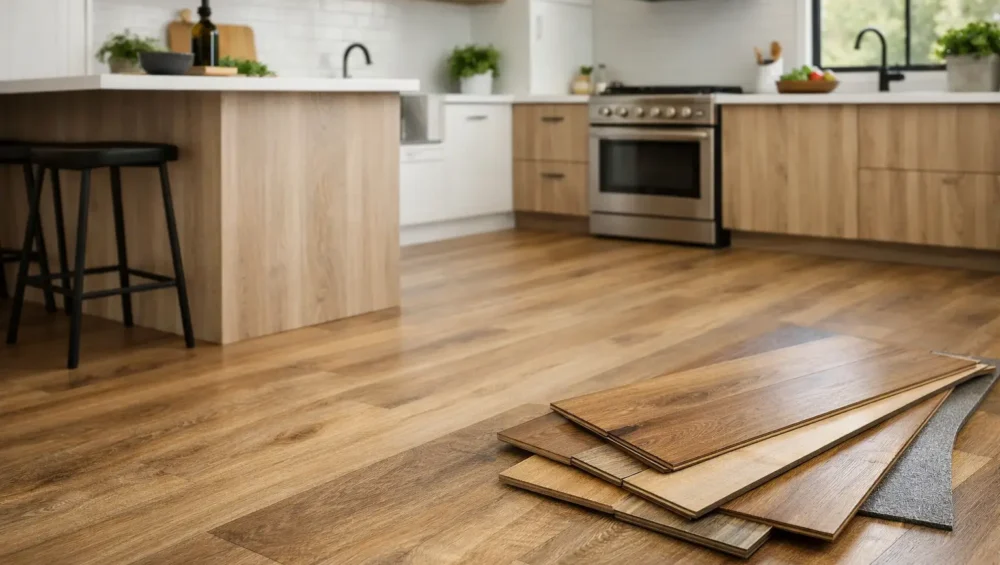
Samples are especially useful here. A floor can shift dramatically depending on natural light, cabinet color, and adjacent materials. Seeing the board in the actual kitchen environment often answers questions faster than any specification sheet can.
Hybrid timber flooring for kitchens makes the most sense when you want warmth, resilience, and a more design-led alternative to colder surfaces. Choose it with care, pair it with the right palette, and the floor will not just support the kitchen – it will shape how the entire space feels every day.