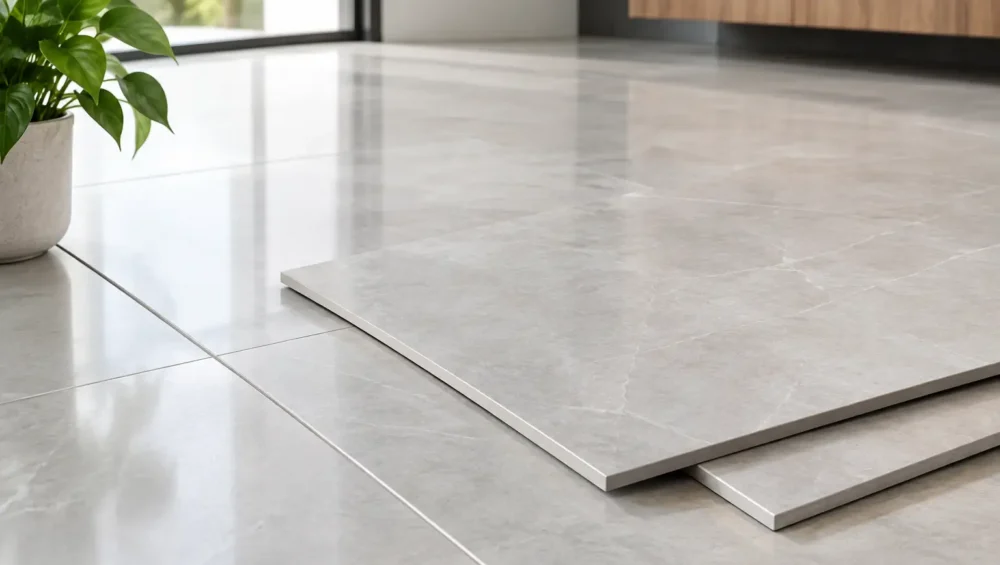
A beautifully tiled room is often defined by the details you barely notice at first: the consistency of the joints, the crispness of the layout, and the way each surface seems to flow without interruption. If you have been asking what is rectified tile, the short answer is that it is tile finished with exceptionally precise, straight edges. That precision opens the door to narrower grout lines and a more tailored, architectural result.
For bathrooms, kitchens, entryways, and elevated commercial interiors, rectified tile is a favorite for good reason. It gives porcelain and ceramic surfaces a clean-lined look that suits everything from quiet stone-look designs to dramatic large-format slabs.
What Is Rectified Tile?
Rectified tile is a ceramic or porcelain tile that has been mechanically cut, or ground, after firing. During firing, tiles can contract and vary slightly in size. Rectification brings every piece back to a highly consistent dimension, with sharper 90-degree edges than a standard pressed tile.
This does not mean the tile is better in every application. It means it has been engineered for a particular finish: precise alignment, refined grout joints, and a more continuous visual plane. Rectified tiles are especially popular in contemporary spaces where clean geometry is part of the design language.
A standard non-rectified tile retains its naturally softened, slightly variable factory edges. Those variations are often subtle, but they call for wider grout joints to accommodate differences from one tile to the next. With rectified tile, installers can set a more exact grid because the tile dimensions are more uniform.
Rectified does not mean grout-free
One common misconception is that rectified tile can be installed with no grout at all. Every tile installation still needs grout joints. They allow for small movement in the installation, help manage minor dimensional variation, and make it possible to keep the layout true over a larger area.
The difference is that rectified tile can generally be installed with slimmer joints than non-rectified tile when the substrate, tile selection, and installer’s workmanship support it. A narrow grout line can look striking, but it should never be so tight that it compromises the installation.
Why the Edge Detail Changes the Look of a Room
The appeal of rectified tile is visual restraint. Smaller, more regular grout joints put greater focus on the tile surface itself, whether that is a soft limestone-inspired porcelain, a concrete finish, or a luminous glazed ceramic.
In a large-format format, this can make a room feel more expansive. Fewer pronounced grout breaks allow the eye to travel across the floor or wall with less interruption. This is particularly effective in open-plan living spaces, spa-style bathrooms, and commercial settings where a polished finish matters.
Rectified edges also make layouts such as straight stack bond, running bond, and grid patterns appear more deliberate. When paired with a grout color close to the tile, the effect is elegant and understated. Choose a contrasting grout, and the precise lines become a feature in their own right.
That said, narrow joints are not the only route to a luxurious result. Handmade-look tile, terracotta, encaustic designs, and many natural stone finishes gain their character from tonal shifts, texture, and imperfect edges. The best choice depends on the atmosphere you want to create, not simply on how slim the grout line can be.
Rectified Tile vs. Non-Rectified Tile
The distinction comes down to manufacturing finish and installation tolerance. Both rectified and non-rectified tiles can be durable, beautiful, and suitable for demanding rooms. A premium porcelain body, the correct slip rating, and suitability for the location remain just as relevant as the edge type.
Non-rectified tile often has a gently cushioned edge. It can feel softer and more traditional, and it is often well suited to designs that embrace warmth, texture, or handcrafted character. Because its dimensions may vary slightly, grout joints are normally wider.
Rectified tile has cleaner, more uniform edges. It is an excellent choice when you want a contemporary, monolithic appearance, especially with larger tiles. However, the precision that creates this look also makes planning and installation more demanding. The cleaner the line, the more visible any unevenness becomes.
Where Rectified Tile Works Best
Rectified porcelain is a versatile option for floors and walls throughout the home. In a bathroom, it can create a calm, gallery-like backdrop around a vanity or walk-in shower. In a kitchen, a rectified backsplash can deliver sharp, even lines behind cabinetry, while larger floor tiles reduce visual busyness in a hardworking space.
It is also a strong choice for entryways, living areas, and retail or hospitality environments. Porcelain rectified tile is especially valued in high-traffic settings because it can combine sophisticated finishes with practical durability and easy day-to-day maintenance.
For outdoor use, focus on more than the edge. Confirm that the tile is rated for exterior conditions, has the right slip resistance for the area, and is appropriate for the local climate. A rectified edge can look exceptional on an outdoor entertaining surface, but performance requirements must lead the decision.
Large-format tile and rectified edges
Many large-format porcelain tiles are rectified because exact sizing helps achieve the sleek, low-joint appearance people expect from these surfaces. The combination can be transformative on expansive floors and feature walls.
It also raises the stakes for installation. Larger tiles need a very flat substrate, appropriate adhesive coverage, and careful leveling. If the floor or wall is uneven, adjacent tile edges may sit at different heights. This is known as lippage, and it is more noticeable with narrow grout joints, glossy finishes, and directional lighting.
What to Consider Before Choosing Rectified Tile
Start with the room and the desired visual effect. If you are designing a minimal, contemporary interior with long uninterrupted lines, rectified tile may be the natural fit. If the project calls for old-world softness or artisanal variation, a non-rectified finish may better honor the material’s character.
Then consider the tile size, finish, and layout. A matte rectified porcelain can be forgiving and quietly refined. A polished, large-format tile will reflect more light and may show deviations in the substrate more readily. Long plank-shaped tiles also need thoughtful layout planning to avoid emphasizing natural bowing that can occur in fired tile.
Grout selection deserves equal attention. A closely matched grout lets the field read as one composed surface. A contrasting grout gives the pattern definition and can bring a graphic quality to a wall or floor. Either approach can work beautifully, provided the joint width is appropriate for the tile and installation conditions.
Finally, choose an experienced tile professional. Rectified tile rewards careful setting-out, a well-prepared substrate, and meticulous spacing. Ask your installer to review the tile before work begins, confirm the recommended joint width, and plan the layout around focal points, doorways, drains, and transitions.
A Note on Shade, Caliber, and Ordering
Even rectified tile can have natural variation between production batches, particularly in stone-look, concrete-look, or richly textured designs. Shade refers to color variation, while caliber refers to size grouping. Rectification makes the edges consistent, but it does not erase intentional variation in the surface design.
For the most cohesive result, order enough tile for the full project at one time, including a sensible allowance for cuts and future repairs. Review samples in the actual room whenever possible. Light changes color, sheen, and texture dramatically from morning to evening, and a sample is the most reliable way to see how a finish will live in your space.
Is Rectified Tile Worth It?
Rectified tile is worth considering when a precise, modern finish is central to the project. It gives designers and homeowners more control over grout-line scale and can make premium porcelain or ceramic surfaces feel especially intentional.
It is not automatically the right answer for every room or every style. A wider-joint, non-rectified tile may be more appropriate for a rustic renovation, a handcrafted look, or a project where the existing substrate cannot be prepared to the flatness demanded by large-format, narrow-joint tile.
The most successful selection balances aesthetic ambition with real-world conditions. Choose the edge profile that supports the character of the surface, invest in proper preparation, and let the tile’s scale, finish, and grout color work together to transform the room.