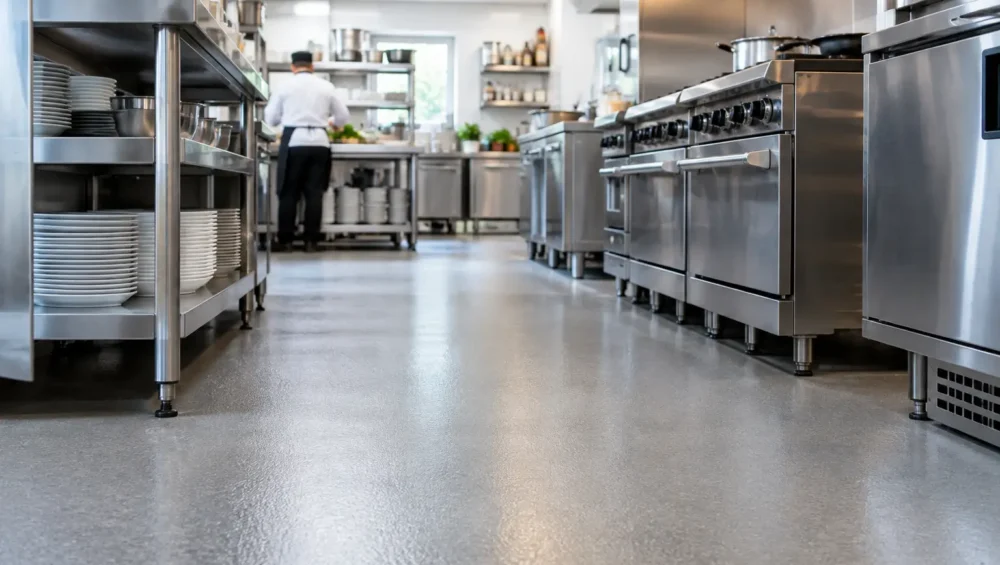
A commercial kitchen floor has one job that matters more than almost any other surface in the building: keep performing when heat, grease, water, heavy equipment, and fast-moving staff all arrive at once. The right commercial kitchen flooring supports a cleaner, safer, more efficient operation while giving the space a finish that reflects the quality of the business behind it.
For restaurants, cafes, hospitality venues, schools, and professional food-prep facilities, flooring is not a background decision. It affects slip risk, cleaning routines, downtime, maintenance costs, and the visual standard of the entire back-of-house environment. A beautifully specified floor that cannot cope with wet traffic is not a luxury. It is a liability.
What Commercial Kitchen Flooring Must Handle
A commercial kitchen is a highly demanding setting. Floors are exposed to temperature changes, dropped utensils, rolling carts, cleaning chemicals, food acids, oils, and repeated washdowns. In high-volume service, they must withstand all of that without becoming difficult to clean or unsafe underfoot.
Slip resistance should be considered alongside cleanability, not instead of it. An aggressively textured surface may improve traction, but excessive texture can trap grease and make daily cleaning more labor-intensive. The goal is a finish with enough grip for the operating conditions, paired with a surface profile that staff can maintain consistently.
Durability matters just as much. Kitchen flooring should resist chipping, cracking, staining, and wear in paths where staff pivot, equipment rolls, and deliveries land. It also needs to remain dependable at transitions, drains, doorways, and walls, where water management and movement are most likely to test the installation.
There is no single best material for every kitchen. The right choice depends on the volume of service, the type of cooking, the cleaning regime, drainage design, local requirements, and the design expectations of the wider venue.
Porcelain Tile for Commercial Kitchen Flooring
Commercial-grade porcelain tile is a refined, hard-wearing choice for many food-service environments. Its low water absorption, stain resistance, and extensive design range make it particularly appealing where practical performance and a premium visual finish need to work together.
Porcelain can create a more considered kitchen environment than the purely industrial finishes often associated with back-of-house spaces. Concrete-look porcelain, stone-look porcelain, and understated neutral tiles can connect an open kitchen to the dining room, allowing the whole venue to feel intentional rather than divided into front and back zones.
For a working kitchen, select porcelain with an appropriate slip-resistant finish rather than a polished surface. Matte, structured, and grip-rated options are generally better suited to wet or spill-prone conditions. Smaller-format tile can also be useful around falls to drains because additional grout joints can contribute to traction and make it easier to form the required slope.
The trade-off is grout. While porcelain itself is exceptionally low maintenance, grout joints need careful specification and installation. A high-performance grout system, correct joint width, and regular cleaning are essential. In grease-heavy kitchens, neglected grout can undermine an otherwise excellent floor.
Where porcelain makes the most sense
Porcelain is especially well suited to cafes, bakeries, prep kitchens, hotel kitchens, open-kitchen concepts, and service areas where design continuity matters. It is also a strong option for dry or moderately wet zones that need a polished commercial finish without sacrificing daily durability.
For the highest-impact cooking lines, dishwashing stations, and areas subject to constant oil or standing water, the tile selection and installation details require even closer scrutiny. A quality tile is only one part of the system.
Other Flooring Options to Consider
Quarry tile has long been a practical choice for commercial kitchens because it is dense, durable, and naturally suited to demanding wet environments. Its traditional appearance is not right for every project, but it remains a dependable option where function leads the brief.
Resinous floors, including epoxy and urethane systems, offer a continuous surface with no grout joints. This can simplify cleaning and produce a highly functional result, particularly in industrial food production or high-volume kitchens. Yet resin systems are not maintenance-free. They depend on meticulous substrate preparation, professional installation, and the correct formulation for thermal shock, chemical exposure, and moisture conditions.
Vinyl and safety flooring can be appropriate for lighter-duty food preparation areas or ancillary spaces. These materials can be comfortable underfoot and offer good slip resistance, but they are not always the best answer for intense heat, dropped cookware, and heavy rolling loads. Seams, edges, and damage from sharp impacts deserve consideration before specifying them for a full commercial kitchen.
Natural stone can introduce a distinctive, elevated character in hospitality settings, but it is generally a more selective choice for active kitchen zones. Many stones are porous and can be affected by acids, oils, and repeated cleaning. If stone is part of the design vision, it may be better reserved for adjacent service areas or carefully managed lower-risk spaces.
Start With the Kitchen Zones, Not Just the Look
The most successful specifications often use more than one flooring solution. A receiving area, cooking line, prep zone, dishwashing station, walk-in cooler, and front-facing service counter do not experience the same conditions. Treating them as identical can result in unnecessary compromise.
The dishwashing zone, for example, may require the most attention to water, drainage, and slip resistance. A dry pantry or pastry room may prioritize comfort, cleanability, and visual cohesion. An open kitchen may need a surface that meets operational requirements while complementing the restaurant’s architecture, millwork, and lighting.
This zoning approach also helps direct investment where it delivers the greatest value. Rather than choosing a single finish based on its appearance in a sample, assess how each area operates during peak service and during end-of-day cleaning.
The Details That Protect the Investment
Even premium commercial kitchen flooring can fail if the installation details are overlooked. Subfloor condition, moisture testing, expansion movement, floor falls, drainage placement, adhesive selection, grout, and wall junctions all influence the finished floor’s lifespan.
Drainage deserves particular attention. Water should move toward drains rather than collect in low points, and tile layouts should be planned around the required falls. This can affect tile size, pattern, and grout-joint placement. A large-format tile may look exceptionally clean in a showroom, but a smaller format can be more practical where a floor needs to slope in several directions.
Coved skirting or an integrated wall-to-floor transition can also improve hygiene by reducing hard-to-clean corners. In spaces subject to frequent washdowns, these details support faster cleaning and a more professional finish.
Before purchasing, confirm the required slip rating, relevant health and building requirements, and the suitability of the selected material for the intended use. These requirements vary by jurisdiction and project type, so the final specification should be reviewed by the project architect, builder, installer, and relevant compliance professionals.
How to Choose a Finish That Still Looks Exceptional
Performance should lead the selection, but it does not need to limit the design. The best commercial surfaces feel composed, even in spaces customers may never see. Neutral porcelain in charcoal, warm gray, sand, or soft concrete tones can conceal day-to-day marks more gracefully than very light or very dark floors. Subtle variation can add depth without making spills or debris harder to spot.
Avoid highly polished finishes in operational zones, even when the broader design leans luxurious. Instead, bring visual distinction through format, restrained texture, tonal variation, or a considered transition into public-facing areas. A well-chosen matte porcelain can feel every bit as premium while being far more appropriate for the task.
Ordering samples is a practical step before committing. View them under the kitchen’s planned lighting, assess texture with wet hands, and compare them against cabinetry, stainless steel, counters, and wall finishes. A sample cannot replace technical review, but it can prevent a costly aesthetic mismatch.
A Floor Built for Service
The right floor allows a commercial kitchen to work hard without looking purely utilitarian. It should give staff confidence underfoot, support efficient cleaning, and hold its finish through years of demanding service. When durability, drainage, slip resistance, and design are considered together, commercial kitchen flooring becomes a long-term asset rather than another item on the maintenance list.
Choose the surface for the reality of the kitchen at its busiest, then refine the color, texture, and format until it feels worthy of the venue you are creating.