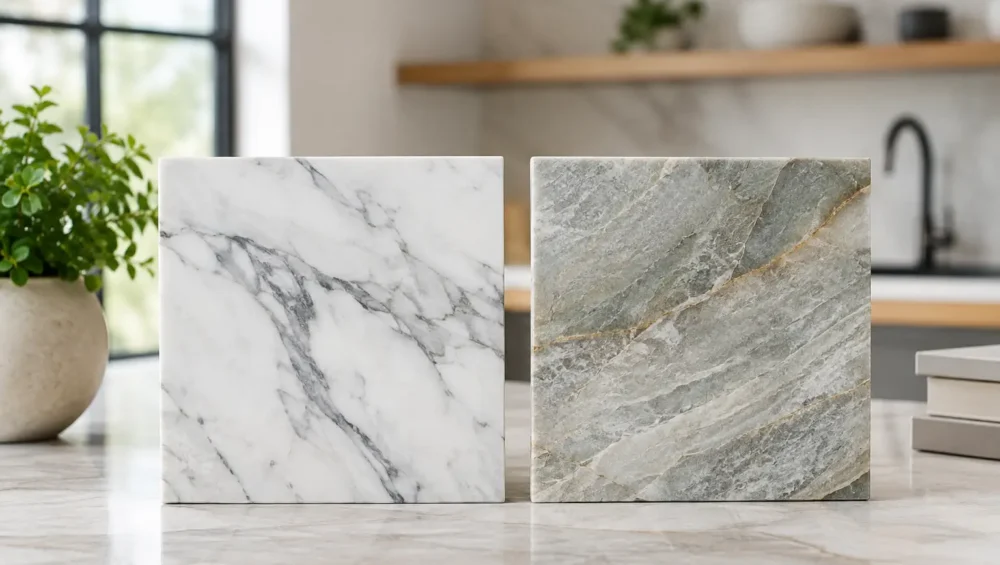
A white stone floor can look quietly luxurious in a sunlit entry, while a richly veined bathroom wall can turn a practical room into a genuine design feature. Yet the choice between marble versus quartzite tiles is more than a question of which pattern catches your eye. These two natural stones have distinct personalities underfoot, different care requirements, and different strengths in the rooms where life happens.
For homeowners and design professionals selecting a premium surface, the right choice comes down to how you want the stone to look, feel, and perform over time. Marble brings unmistakable elegance and soft movement. Quartzite delivers a similarly elevated natural look with greater resistance to daily wear. Both can transform a space when chosen with the room, finish, and installation in mind.
Marble Versus Quartzite Tiles: The Essential Difference
Marble is a metamorphic stone formed when limestone is transformed by heat and pressure. Its signature veining, gentle translucence, and layered color variation have made it a design classic for centuries. From crisp white and gray palettes to warmer beige, green, and richly dramatic varieties, marble has a visual depth that manufactured materials work hard to imitate.
Quartzite is also a metamorphic stone, but it begins as sandstone. Under immense heat and pressure, the quartz grains fuse together, creating a denser and generally harder material. It often features sweeping veins, crystalline texture, and tonal variation that can resemble marble at first glance. Look closer, and many quartzites reveal a more granular, sparkling character with a sense of geological movement.
The names matter because natural stone is not interchangeable. A tile labeled as quartzite should not be assumed to have the same behavior as marble, and vice versa. Ask about the specific stone selection, finish, recommended sealant, and intended application before making a final decision.
Choose Marble for Soft, Iconic Elegance
Marble is chosen for atmosphere. It has a calm, luminous quality that suits spaces where visual refinement is the priority: a powder room floor, a fireplace surround, a statement shower wall, or a formal foyer. Veining ranges from barely there to bold and expressive, allowing marble to work in restrained contemporary interiors as easily as in classic or European-inspired schemes.
A honed marble tile has a soft matte finish that feels sophisticated and relaxed. It is particularly effective in bathrooms, where a less reflective surface can support a serene, spa-like setting. Polished marble creates more drama, reflecting light across an entryway, feature wall, or low-traffic floor. The finish changes the experience of the stone, not just its appearance.
Its trade-off is sensitivity. Marble is softer than quartzite and contains calcium carbonate, which can react with acidic substances. Lemon juice, vinegar, wine, and some cleaning products may leave etching marks, especially on polished surfaces. Etching is not always a stain – it is a change in the surface itself, often appearing as a dull or lighter area.
That does not mean marble is impractical. It means marble rewards a considered approach. In a bathroom, bedroom, powder room, or carefully maintained entry, it can age beautifully. In a busy family kitchen or a high-use commercial setting, some clients welcome the developing patina; others prefer a stone with fewer maintenance demands.
Where Marble Tiles Work Best
Marble is especially compelling on vertical surfaces, where its beauty can take center stage without the same level of daily abrasion. Consider it for bathroom walls, shower surrounds, backsplashes, fireplace cladding, and decorative floor zones. For wet areas, select a finish with suitable slip resistance and confirm that the tile, grout, substrate, and installation system are appropriate for the application.
On floors, honed marble is often the more forgiving option. Its understated finish disguises minor wear better than a high-polish surface, while preserving the stone’s natural elegance.
Choose Quartzite for Greater Everyday Resilience
Quartzite appeals to those who want a natural stone surface with visual drama and stronger everyday durability. Because it is generally harder and more scratch-resistant than marble, quartzite is an excellent candidate for active households, busy entrances, kitchen floors, and commercial spaces where a premium finish still needs to work hard.
Its natural variation is one of its greatest strengths. Some quartzite tiles are light and airy, with white, gray, or sandy tones that create a refined coastal or contemporary look. Others introduce smoky blues, greens, gold, or warm mineral notes. The effect can be bold without feeling overly formal, making quartzite a compelling choice for interiors that need texture and character.
Quartzite is not maintenance-free, however. Natural stone is porous to varying degrees, and many quartzites should be sealed to help protect against moisture and staining. Sealant does not make stone invincible, but it gives you more time to wipe up spills before they penetrate the surface. Regular care remains simple: use a pH-neutral stone cleaner, avoid harsh abrasives, and clean spills promptly.
Where Quartzite Tiles Work Best
Quartzite is well suited to floors in kitchens, hallways, mudrooms, living areas, and other high-traffic zones. It can also perform beautifully in bathrooms and on feature walls, especially when you want a stone that feels less formal than classic marble but remains undeniably luxurious.
For outdoor projects, suitability depends on the exact quartzite, tile finish, local climate, installation method, and whether the material is rated for exterior use. A textured finish can offer improved traction, but outdoor stone should always be selected for the conditions it will face, including freeze-thaw cycles, water exposure, and direct sun.
Comparing Appearance, Feel, and Performance
Marble and quartzite are both premium choices, but they create different design conversations. Marble tends to feel soft, romantic, and timeless. Its veining can be delicate and cloud-like or sharply graphic, and it works beautifully when the goal is a polished, architectural statement.
Quartzite often feels more textured, earthy, and dimensional. It can mimic the sophistication of marble while bringing a slightly more organic presence to a room. If your palette includes natural timber, warm metals, plaster finishes, or sculptural lighting, quartzite can create an especially balanced composition.
Underfoot, both materials offer the cool, solid feel that makes natural stone so distinctive. Larger-format tiles reduce grout lines and let the stone’s movement read more continuously. Smaller formats, mosaics, or patterned layouts can introduce detail and traction, particularly in bathrooms and compact spaces.
Durability is where quartzite usually takes the lead. It is generally harder and less prone to etching than marble. Marble requires more willingness to maintain and accept the marks of use. Neither material should be selected solely on a hardness comparison, though. Tile finish, installation quality, grout selection, sealing, and daily habits all affect long-term performance.
Maintenance That Preserves the Finish
Whether you choose marble or quartzite, proper care protects the investment and helps the stone retain its character. Seal natural stone according to the product guidance and the demands of the space. High-use or wet areas may need more frequent attention than a decorative wall.
For everyday cleaning, sweep or vacuum grit from floors, then use a soft mop and a stone-safe, pH-neutral cleaner. Avoid bleach, acidic cleaners, bathroom sprays with aggressive chemicals, and abrasive pads. These can dull the finish, weaken sealers, or damage the surface over time.
It is also wise to use entry mats in exterior-facing doorways and felt protection beneath movable furniture. In kitchens and dining spaces, wipe acidic spills quickly. These small habits make a noticeable difference, particularly for polished marble.
How to Make the Right Selection
Start with the room, then work backward to the stone. If you are creating a showpiece powder room, a light-filled foyer, or a refined fireplace, marble may offer the exact level of elegance you are after. If the surface will see children, pets, frequent entertaining, rolling chairs, or commercial foot traffic, quartzite may provide greater peace of mind.
Then consider the sample in the actual space. Natural stone varies from piece to piece, which is part of its appeal. View samples beside cabinetry, paint, fixtures, and flooring at different times of day. A cool white marble may become warmer in afternoon light, while a quartzite’s mineral flecks may come alive under layered lighting.
Finally, choose a finish that supports the way the room will be used. Honed stone brings a softer, more forgiving look. Polished stone adds reflection and formality. Textured finishes can be a stronger fit for wet zones or exterior applications when rated for those environments.
The most memorable interiors do not choose materials simply because they are beautiful. They choose them because the beauty belongs in that particular room, with that particular lifestyle. Order samples, compare the surface in your own light, and let the stone that feels right for the space lead the design.